2026/06/09
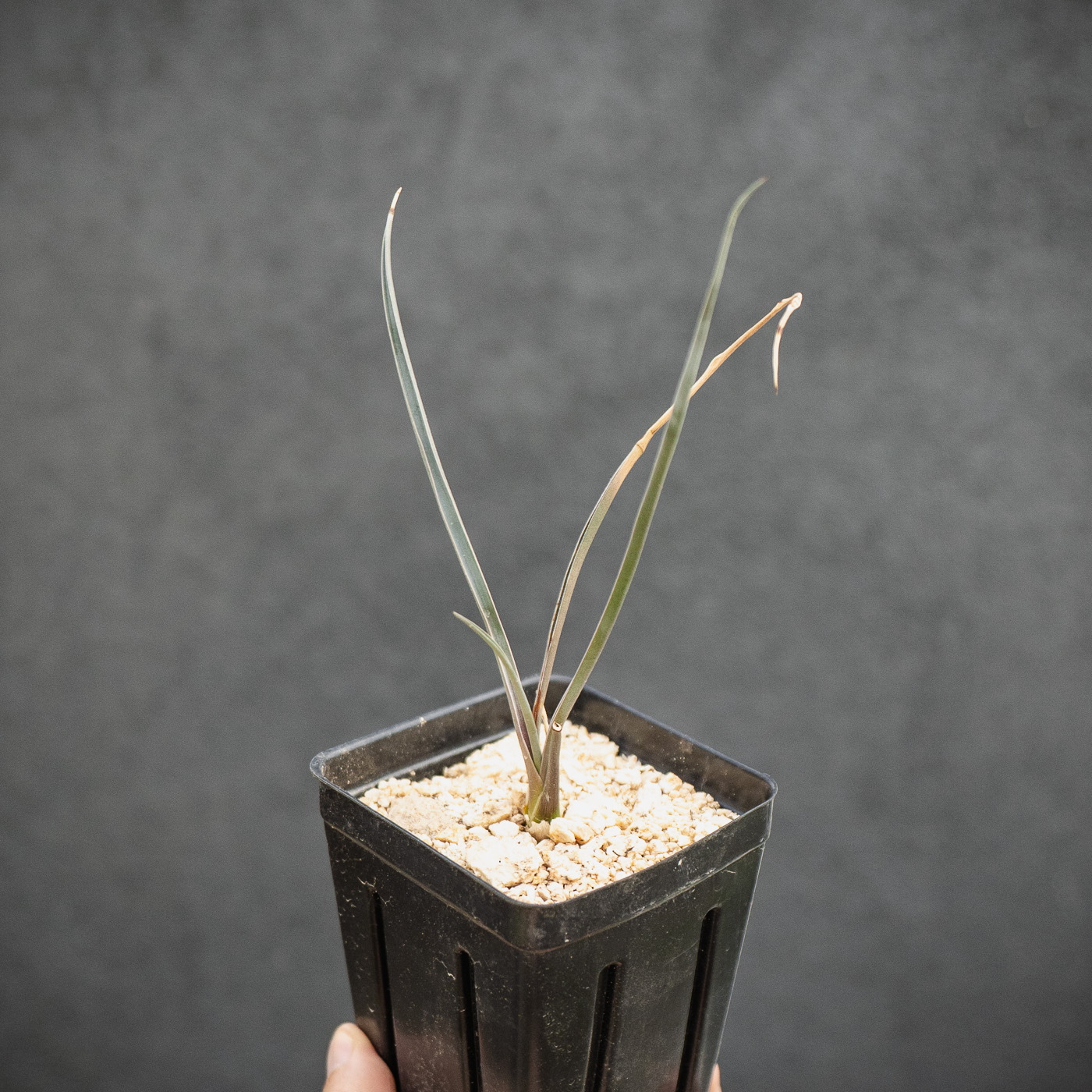
Yucca brevifolia subs. jaegeriana
Pygmy Joshua Tree
Acquired3 months ago6/8/2026
Notes
The Jaeger Joshua Tree focuses its primary vegetative growth and cellular expansion during the cool, moist months of winter and early spring, capitalizing on winter Pacific storms. It produces dense panicles of heavy, cream-colored, semi-globose flowers at the branch apices between March and May, a reproductive event tightly bound to a symbiotic relationship with its exclusive pollinator, the yucca moth (Tegeticula jaegerimus). During the intense, arid heat of mid-summer, the plant enters a highly protective, low-metabolic state to minimize water loss through its rigid, dagger-like leaves. In cultivation, it demands an exceptionally deep, sharp-draining, coarse mineral substrate to accommodate its wide-spreading, thick root system, and must be watered with an opportunistic but restrained hand during late winter and spring, leaving it mostly dry throughout the scorching summer months.
Origin
Southwestern United States. This distinct subspecies occupies the eastern range of the Mojave Desert, primarily localized across eastern California (such as the Mojave National Preserve), southern Nevada, and northwestern Arizona. Unlike the taller, single-trunked western nominate subspecies (Y. brevifolia subs. brevifolia), the Jaeger Joshua Tree is notably smaller and more compact. It undergoes a highly characteristic, heavy low-altitude branching pattern, frequently splitting into a dense, multi-stemmed structure directly near the base. It populates exposed desert flats, gentle alluvial fans (bajadas), and rocky slopes between 900 and 1,800 meters, typically growing in association with creosote scrub, Yucca schidigera, and various opuntias.
Note: Coordinates indicate a general region for educational purposes and are not exact locations. Please do not use them for collection or poaching.