2026/07/28
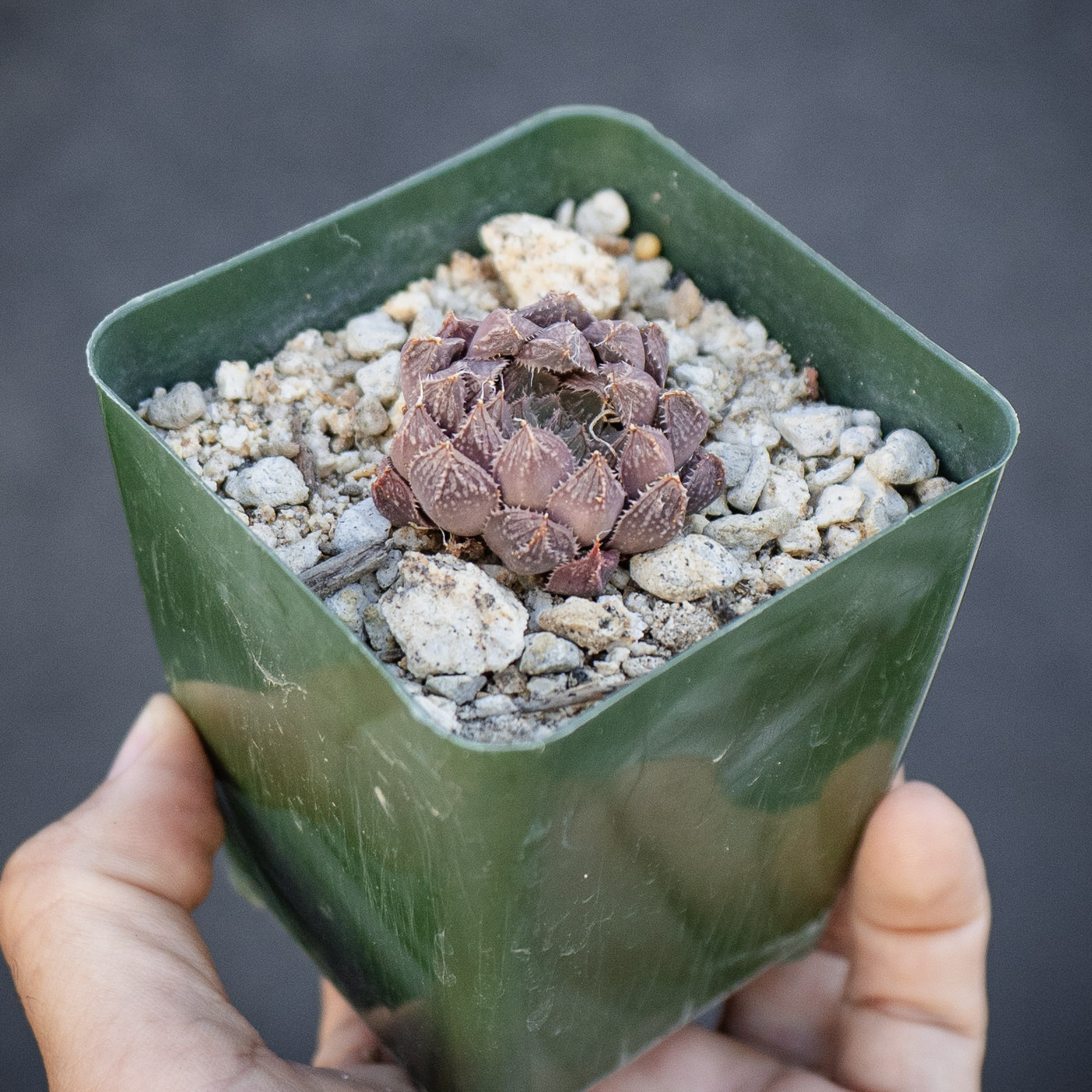
Haworthia cooperi hybrid cv. Mirror Ball
Acquired4 months ago5/22/2026
Notes
This cultivar drives its main metabolic activity, root growth, and leaf plumping during the mild, temperate days of autumn and spring. It slows its growth down significantly during mid-winter chills and the stagnant heat of mid-summer, relying on its subterranean root system and water-gorged leaves to stay stable. Under ideal bright, filtered light and mild day-to-night temperature swings, the translucent windows take on a luminous silvery sheen, while the margins flush with soft pink or bronze hues. It produces tiny, tubular white flowers on slender, simple stalks in late spring. In cultivation, it has an absolute intolerance for damp, suffocating soil, which can cause its thick, fleshy roots to instantly hollow out and die; it thrives best in an incredibly porous, gritty mineral substrate (such as 85% to 90% akadama, premium pumice, and fine gravel) and must be watered only when the potting medium is completely bone-dry.
Origin
Cultivar origin (highly selected hybrid). This iconic, gem-like succulent is a specialized horticultural hybrid created by Japanese master breeders, specifically derived from select crossings of Haworthia cooperi lineage (likely involving H. cooperi var. truncata). While its precise form was perfected in cultivation, its genetic lineage traces directly back to the Eastern Cape Province of South Africa, where its wild ancestors grow nestled in the shade of low shrubs and rocky quartz fields, often buried up to their leaf tips in gritty soil. 'Mirror Ball' is highly celebrated for its perfectly symmetrical, tight, spherical rosette that stays incredibly compact. Its leaves are thick, short, and intensely plump, featuring translucent, glass-like apical windows. These windows are intricately patterned with fine, green-to-purplish longitudinal lines and fringed with tiny, bristly teeth along the margins and keels, making the entire plant shimmer like a multifaceted disco ball under bright light.
Note: Coordinates indicate a general region for educational purposes and are not exact locations. Please do not use them for collection or poaching.