2026/07/04
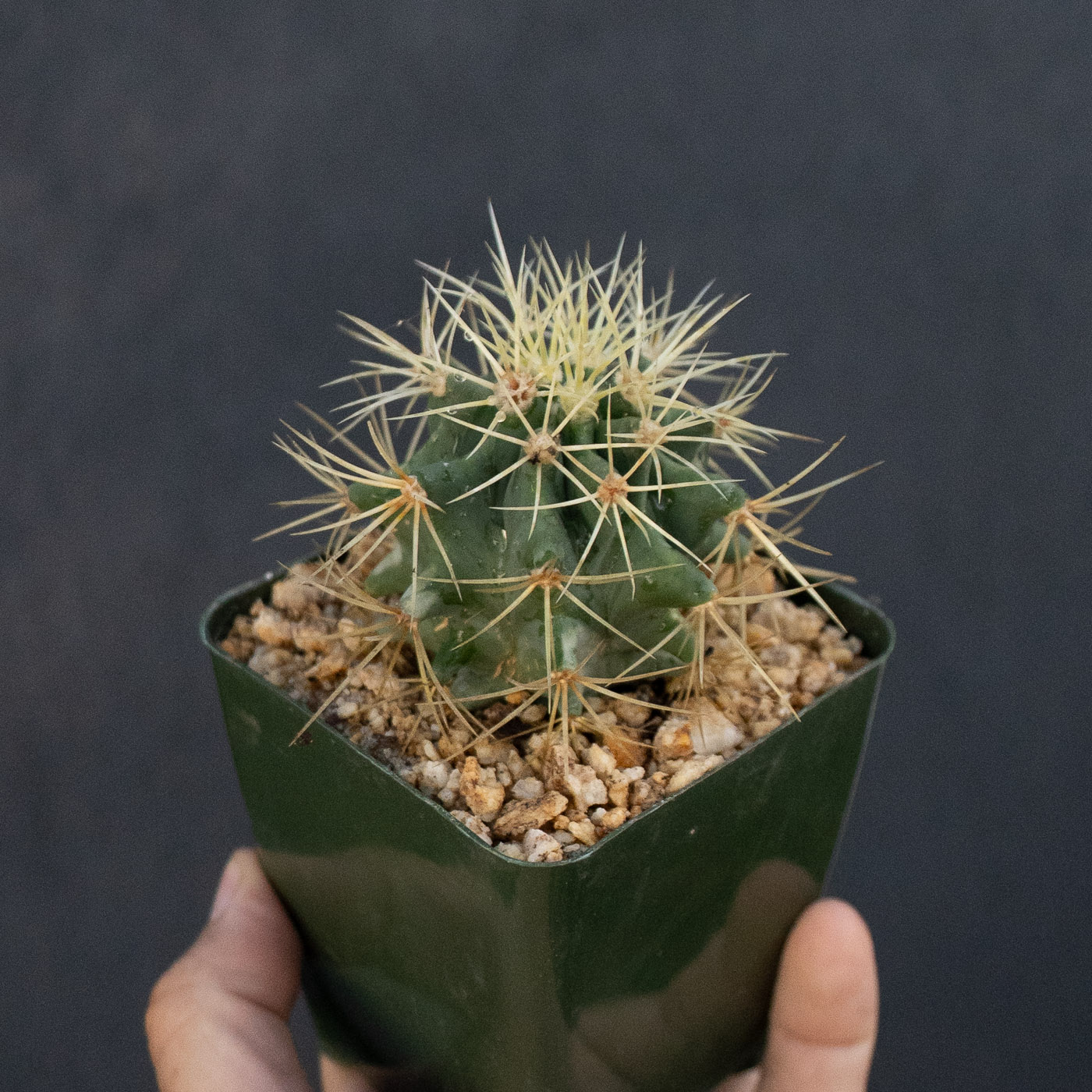
Ferocactus glaucescens
Blue Barrel Cactus
Acquired3 months ago7/2/2026
Notes
This mountain species is a robust summer grower, pacing its primary vegetative growth, heavy root expansion, and beautiful golden spine production with the warm spring and summer months, which align with the convective summer rains of the Mexican plateau. In late spring and throughout summer, mature specimens produce a spectacular, multi-day ring of satiny, campanulate, lemon-yellow flowers directly around the woolly apex, followed by spherical, fleshy white fruits. During the winter, the plant enters a restful dormancy where it can tolerate brief, near-freezing drops if kept completely dry. In cultivation, it has a strong root system but requires excellent drainage to maintain its pristine, rot-free base. It thrives in a highly porous, well-aerated mineral mix (such as 70% to 80% premium volcanic pumice, coarse grit, and crushed limestone) and responds incredibly well to thorough, deep waterings during the active season only when the medium has dried out completely.
Origin
Mexico. This highly ornamental, visually striking barrel cactus is native to the limestone hills, steep canyon walls, and semi-arid matorral shrublands of central Mexico, primarily concentrated within the states of Hidalgo, Querétaro, and San Luis Potosí. Growing at elevations between 1,000 and 2,300 meters, it thrives in hyper-mineral, alkaline conditions. *Ferocactus glaucescens* is intensely celebrated for its striking color contrast and elegant, geometric symmetry. The stem is solitary and globally depressed when young, slowly maturing into a stately, globose-to-cylindrical barrel that can reach 40 to 55 cm in diameter. The defining hallmark of the species is its smooth, flawless, matte pruinose epidermis, which is heavily coated in a thick, chalky blue-grey or glaucous cuticular wax. This frosty blue body is beautifully contrasted by 11 to 15 prominent, acute, non-tuberculate ribs that are neatly lined with closely set, felted areoles. Out of these areoles erupt a remarkably uniform, golden-yellow armor of rigid, straight-to-slightly-curved radial and central spines that don't hook, keeping the clean, architectural profile of the barrel fully intact.
Note: Coordinates indicate a general region for educational purposes and are not exact locations. Please do not use them for collection or poaching.