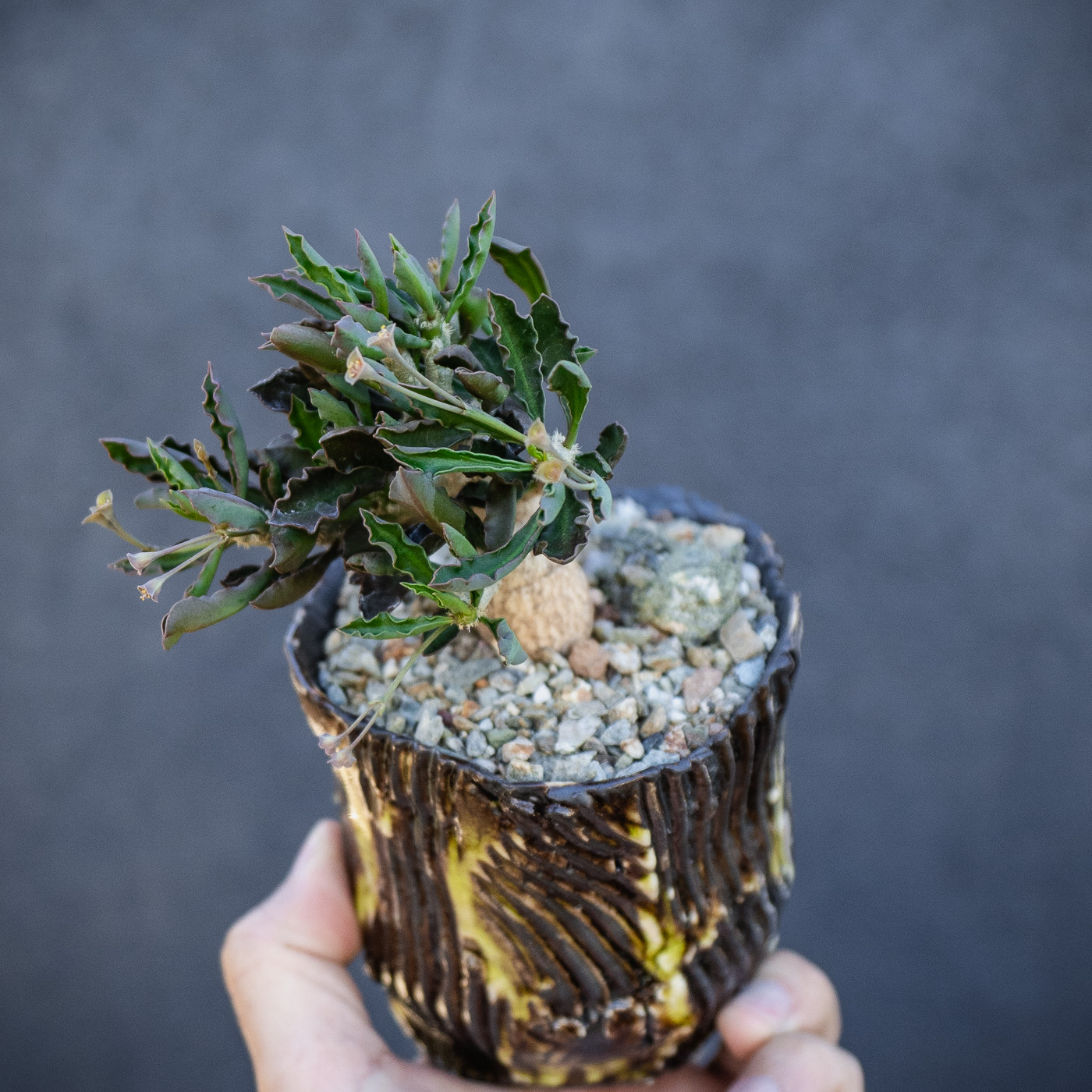
Euphorbia decaryi var. cap-saintemariensis
Notes
Native to a warm, coastal tropical desert climate with summer rainfall and warm, dry winters, this species thrives in high temperatures and bright, filtered sun to direct light. In a coastal Zone 10b environment, providing strong UV light and warmth encourages rich leaf coloration, compact wavy foliage, and caudex development. Unlike Mediterranean winter-growers, it slows down or goes fully dormant when temperatures drop during winter. It demands an exceptionally porous, mineral-heavy substrate with a strong calcareous or mineral component, making your 80% volcanic pumice blend cut with coarse decomposed granite and calcined clay ideal to replicate its native limestone grit. Cultivating this dwarf caudiciform in a shallow, highly breathable raw cement pan ensures rapid drainage and aeration around its fleshy roots and subterranean stems. Water regularly during warm spring and summer growth cycles, allowing the substrate to dry out substantially between soakings, and reduce watering to a strict minimum (or complete dryness) during cool winter dormancy beneath a solid polycarbonate roof to protect against cold, wet decay.
Origin
Madagascar. Endemic to an extremely restricted, wind-swept coastal limestone plateau at Cap Sainte-Marie, the southernmost tip of Madagascar. In its harsh native habitat, it grows fully exposed to intense maritime sunlight, high salty winds, and thin pockets of calcareous grit nestled within limestone crevices. It is a prized dwarf succulent forming low-growing, spreading mats of thickened, gnarled, subterranean to semi-exposed caudiciform branches. The tiny, spirally arranged leaves are thick, succulent, and dramatically crinkled or wavy along the margins, exhibiting a rich bronze, reddish-brown, to deep olive-green hue under strong light. Inconspicuous, chartreuse-to-pinkish bell-shaped cyathia (cyathophylls) appear near the stem tips during warm periods.
Note: Coordinates indicate a general region for educational purposes and are not exact locations. Please do not use them for collection or poaching.