2026/08/05
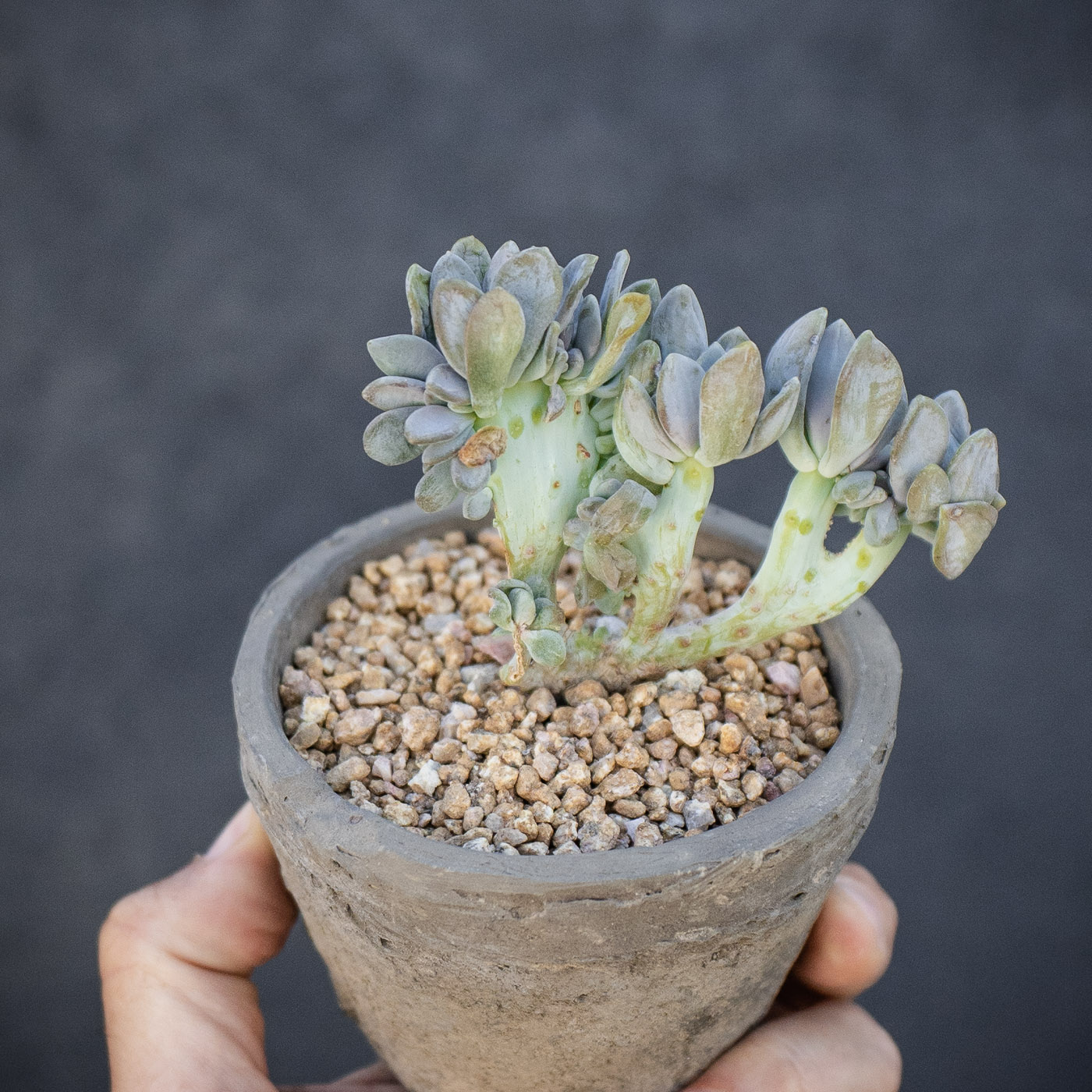
Echeveria sp f. crested
Acquiredabout 2 months ago7/29/2026
Notes
Echeverias are primarily active during the warmer months, though they prefer mild temperatures and can slow down during extreme summer heat. Because the fasciated stem is entirely exposed to the sun and often lacks the waxy protective coating (farina) found on typical rosettes, crested forms can burn easily. They perform exceptionally well outdoors in coastal Zone 10b under the bright, diffused light of a polycarbonate and wood shade house, which provides necessary UV protection while maintaining high luminosity. If planting them in hand-crafted raw cement pots, it is critical that the concrete is fully cured and leached beforehand to prevent an alkaline spike from shocking the shallow root system.
The most significant challenge with a crested Echeveria is pest management. The dense, tightly folded, labyrinth-like growth creates the ultimate hiding place for mealybugs and mites. Egg masses can easily establish deep within the crevices where topical botanical sprays simply cannot reach. This requires intense visual scouting; if an infestation takes hold in the folds, rotating to a systemic treatment is almost always necessary to eradicate the pests from the complex stem structure completely. They require a highly porous, fast-draining mineral mix and should be watered at the base—keeping the dense folds dry to prevent stem rot.
Origin
The Echeveria genus is largely native to the mountainous, semi-arid regions of Mexico, Central America, and northwestern South America. However, the cristata (crested) form is not a distinct species or geographical variant; it is a spontaneous genetic mutation—known as fasciation—that can occur in almost any Echeveria species or hybrid. Instead of growing from a single, central apical point to form a symmetrical rosette, the growth center widens and elongates into a horizontal line. This produces a spectacular, flattened, fan-like or highly undulating stem completely covered in hundreds of tiny, tightly packed, distorted leaves that often resemble a coral reef or a brain.
Note: Coordinates indicate a general region for educational purposes and are not exact locations. Please do not use them for collection or poaching.