2026/06/19
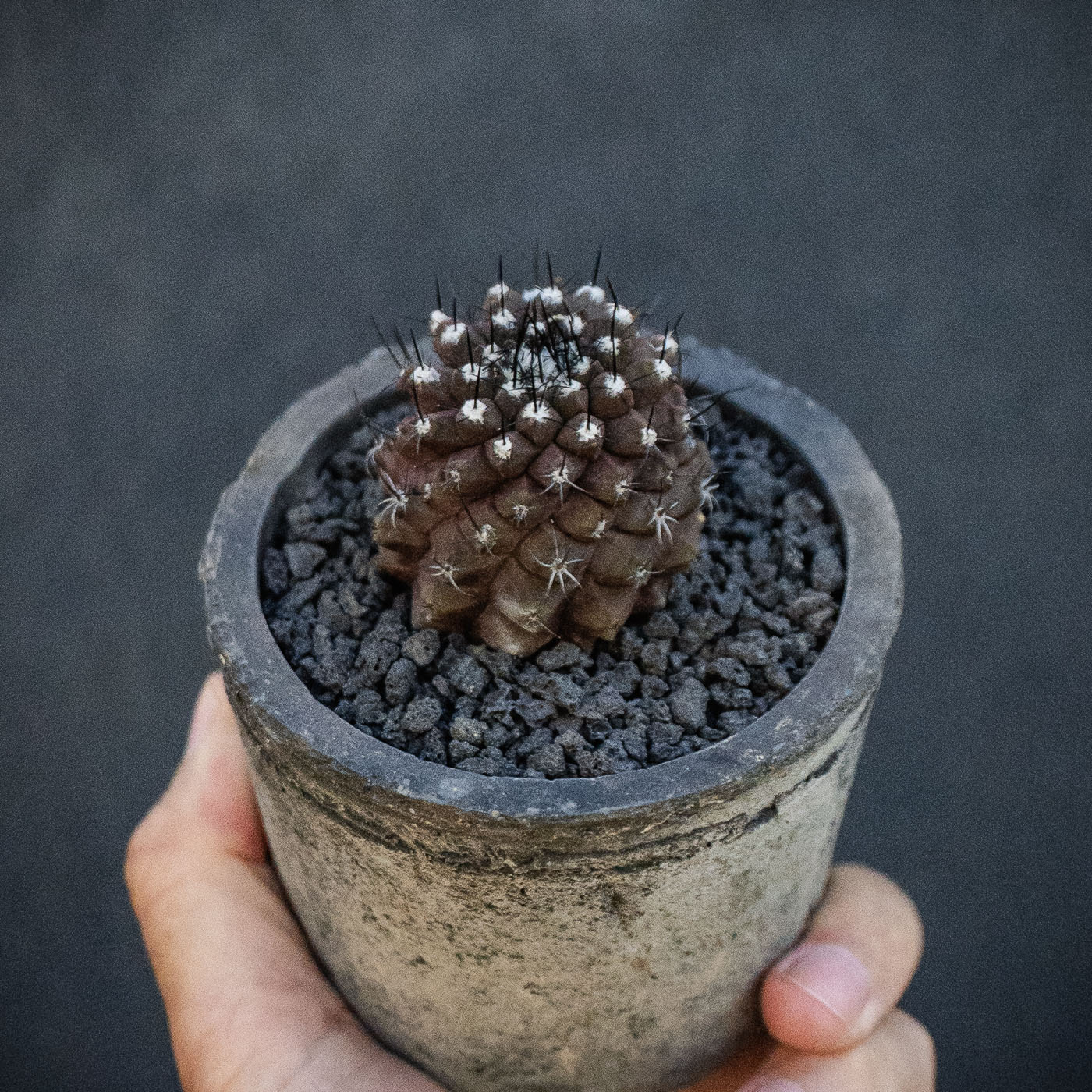
Copiapoa hypogaea var. barquitensis
Acquired9 months ago12/6/2025
Notes
Living in a hyper-arid habitat that receives almost no true rainfall, this variety relies entirely on the dense, low-altitude coastal fog (camanchaca) that sweeps inland over the Barquito bluffs during the cooler autumn, winter, and spring months. The plant condenses this airborne moisture and stores it in a massive, carrot-like tuberous taproot that is vastly larger than the small stem visible above ground. During times of severe drought or the intense heat of mid-summer, the stem loses turgor pressure and is pulled downward by the contracting taproot, shrinking entirely beneath the surface gravel to escape sun-scorching. In late spring and summer, it pushes relatively large, satiny, bright yellow flowers directly from the apex. In cultivation, it requires an aggressively sharp-draining, strictly mineral substrate (such as 90% premium pumice and decomposed granite with zero uncomposted organics) and must be watered with an disciplined, highly restrained hand only during warm, breezy weather when the medium is bone-dry.
Origin
Chile. This highly localized, miniature succulent is strictly endemic to a narrow coastal band within the Atacama Desert, centered around the rocky sea cliffs and barren, gravelly terraces north of the port town of Chañaral, near Barquito. The name hypogaea literally translates to "underground," highlighting the species' adaptation to grow nearly flush with or entirely buried beneath the desert soil. The barquitensis variety is highly distinct from the type species due to its intensely pigmented skin and robust spination; it develops small, globose, highly depressed stems (typically only 3 to 5 centimeters in diameter) that exhibit a rich, oily metallic-bronze, copper, or deep purplish-brown epidermis. Its ribs are broken into low, rounded tubercles, each topped with a felted areole bearing short, rigid, downward-curving black-to-dark-brown spines that flatten against the stem body.
Central coordinates:
Note: Coordinates indicate a general region for educational purposes and are not exact locations. Please do not use them for collection or poaching.