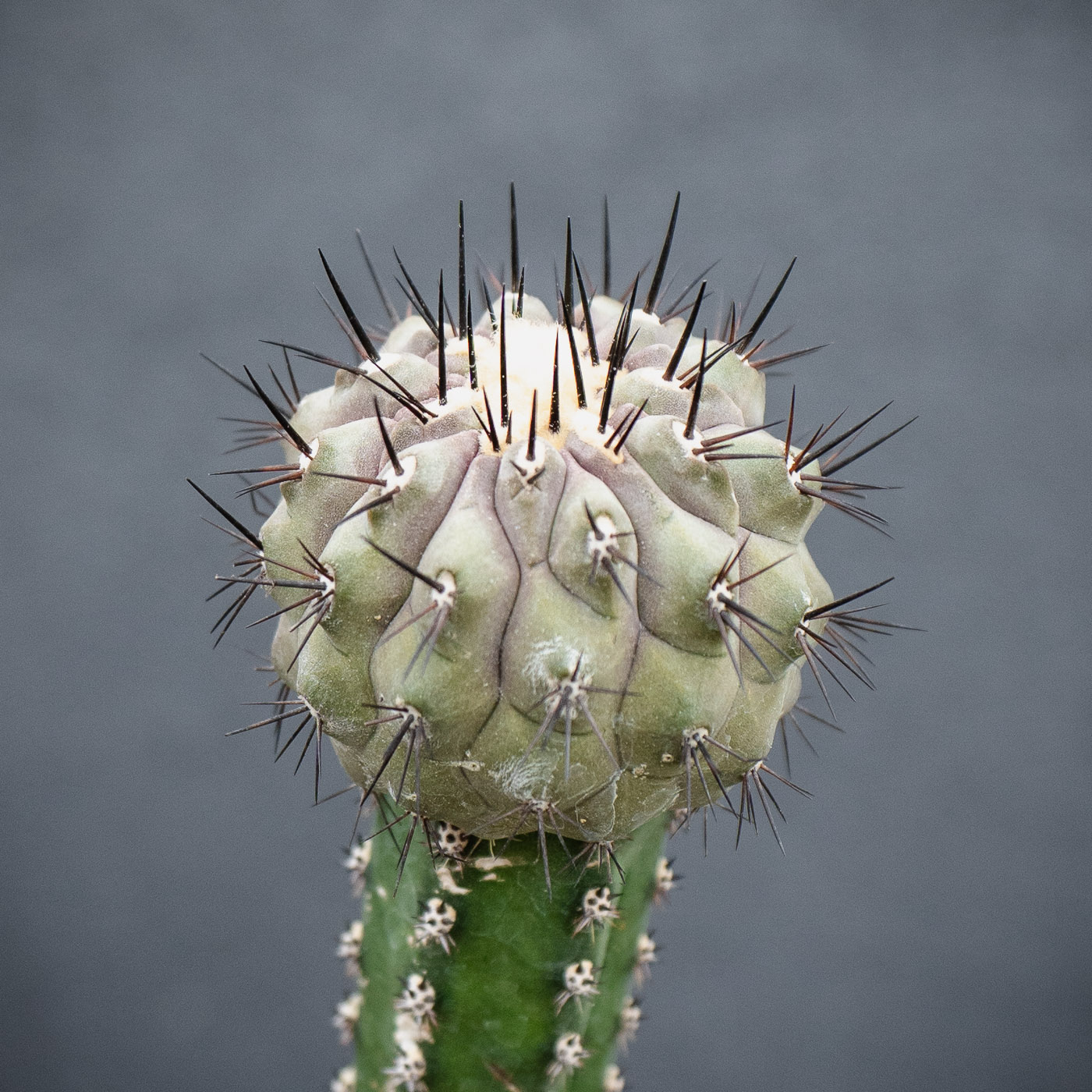
Copiapoa cinerea
Acquired13 days ago11/9/2026
Notes
While wild-collected Copiapoa specimens are strictly slow-growing fog-dependents on deep, sensitive taproots, a grafted specimen fundamentally shifts the cultural dynamics to match the rootstock (typically robust summer-active species like Trichocereus / Echinopsis, Myrtillocactus, or Harrisia). In a coastal Zone 10b environment, the rootstock dramatically increases growth rate, nutrient uptake, and water tolerance, eliminating the fragile taproot vulnerability of the scion. However, maximum unfiltered UV sunlight and high airflow remain critical: without intense sun, the C. cinerea scion will fail to produce its characteristic chalky white epicuticular wax layer, leading to a smooth green, unnatural appearance. Maintain a high-mineral substrate (such as your 80% pumice blend cut with decomposed granite and calcined clay) in a porous raw cement pot to ensure the vigorous rootstock remains healthy, well-aerated, and rot-free. Water the rootstock generously during warm summer growth periods—allowing the medium to dry out completely between soakings—and enforce a cool, dry winter rest beneath a solid polycarbonate roof to preserve scion compact form and prevent rootstock rot while dormant.
Origin
Chile (horticultural specimen of wild-origin lineage). Copiapoa cinerea is native to the hyper-arid coastal headlands and granitic slopes of the Atacama Desert, centered between Taltal and Paposo (-25.250, -70.450). In habitat, pure species grow in gravelly marine terraces fully exposed to sea spray, intense solar radiation, and camanchaca fog. Horticultural hybrids often combine characteristics of C. cinerea with related coastal species (such as C. haseltoniana or C. gigantea), manifesting in varying spine color, altered rib counts, or modified epicuticular wax density while maintaining the characteristic grey-green to chalky body and apical wool cushion.