2026/08/14
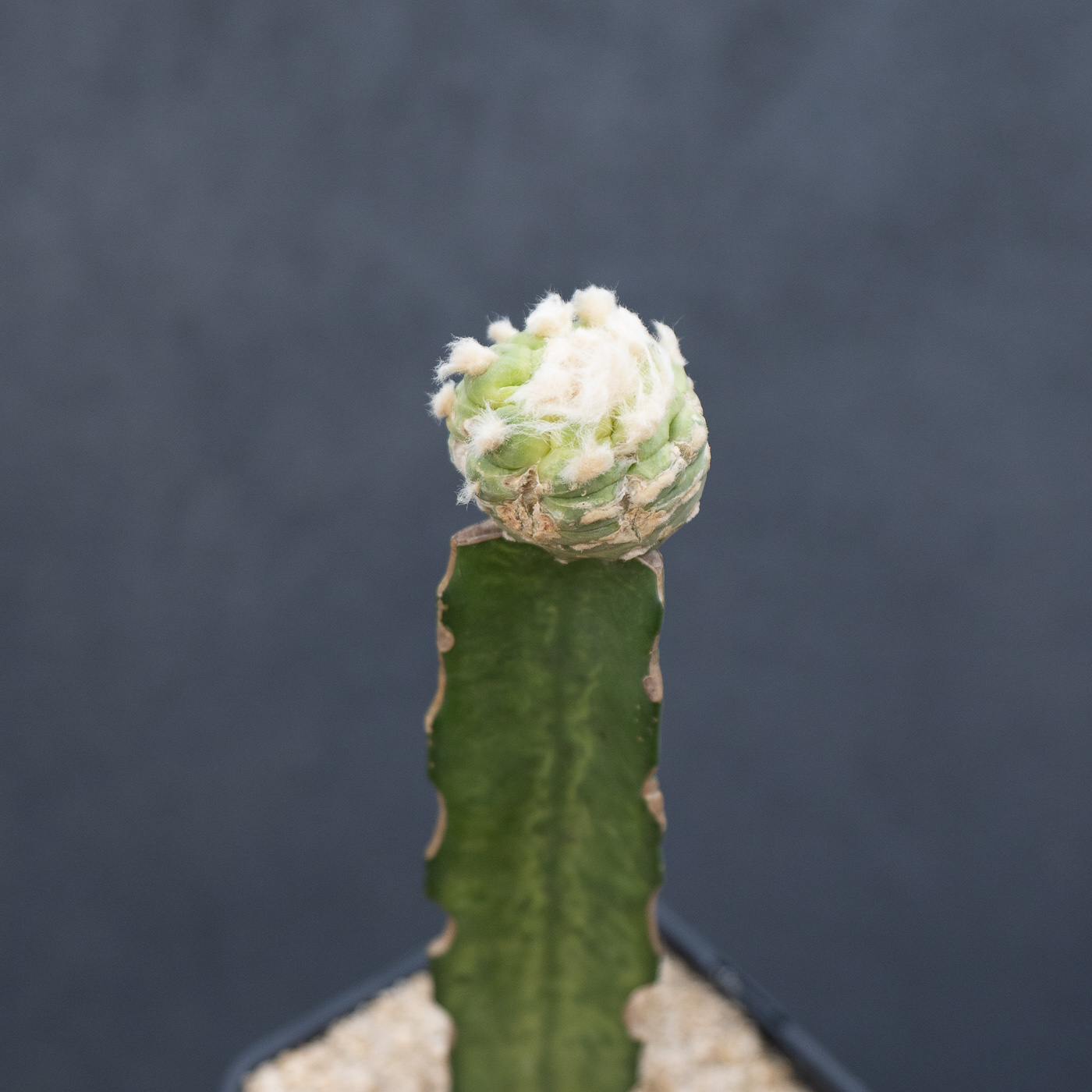
Copiapoa cinerea f. cristata inermis
Acquiredabout 1 month ago8/11/2026
Notes
Retaining the physiological adaptations of its wild ancestry, this mutant drives its metabolic activity during the cooler, highly humid shoulder seasons. Because it lacks spines—which naturally provide partial shade and break up air currents—and features tightly packed, undulating folds, the plant is intensely sensitive to localized moisture trapping and severe epidermal scorching under direct midday sun. In cultivation, it requires meticulous airflow and a strictly mineral, alkaline substrate (such as 90% premium pumice, crushed granite, and a touch of limestone grit with zero uncomposted organics). Water should be applied with extreme discipline only during warm, breezy weather when the medium is completely bone-dry. It must be kept completely dry, well-ventilated, and protected from frost throughout its deep winter rest to prevent the compressed, fleshy folds from falling victim to fungal rot.
Origin
Cultivation origin (mutation of a Chilean endemic). While the genetic blueprint of the underlying species is strictly native to the hyper-arid coastal cliffs and gravel terraces of Taltal within the Atacama Desert, this specific form is a highly stabilized, multi-mutation combination that arises almost exclusively in specialist collections. It merges two distinct anomalies simultaneously: f. cristata (crested growth), where the apical meristem multiplies along a linear axis to create undulating, brain-like ridges, and f. inermis (spinelessness), which entirely suppresses the development of the rigid, black spines typical of the nominate species. The result is a smooth, sculpted, undulating crest of pure, powdery chalk-white to glaucous-grey cuticular wax, punctuated only by small, bare, woolly areoles along the folding crest line.
Note: Coordinates indicate a general region for educational purposes and are not exact locations. Please do not use them for collection or poaching.