2026/09/14
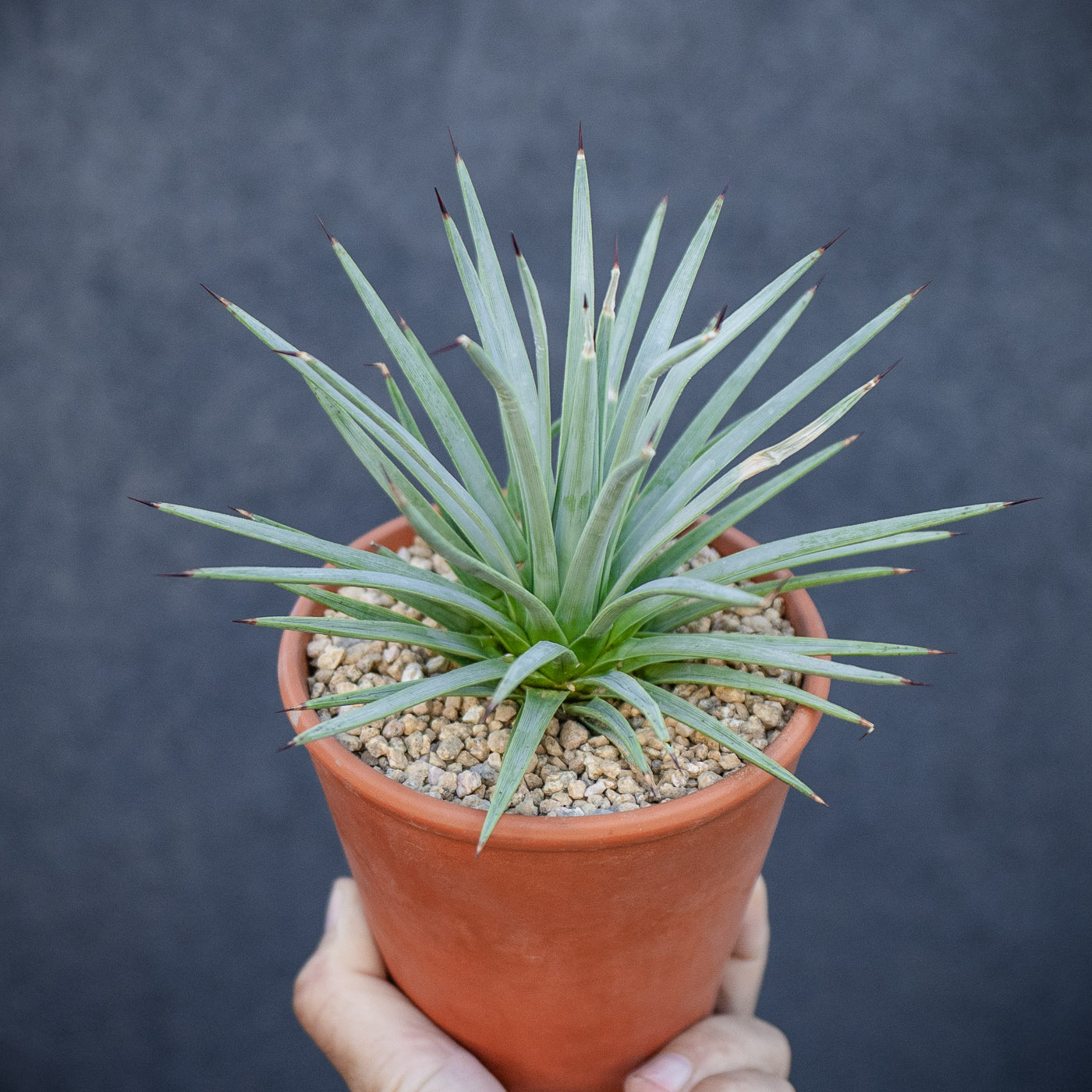
Agave rzedowskiana
Acquired6 days ago9/11/2026
Notes
Unlike hyper-desert agaves, this high-alpine cliff dweller is adapted to a more humid environment with distinct summer monsoon patterns. It is active primarily from late spring through autumn, pushing out a tight succession of new leaves and expanding its fibrous root network. When mature, it sends up a dense, unbranched spicate (spike-like) inflorescence reaching 1 to 1.5 meters tall, densely packed with small, pairs of greenish-yellow to purplish flowers. Because it inhabits rocky vertical bluffs where water drains away instantly, it cannot handle stagnant moisture around its base or roots. In cultivation, it thrives in a highly porous, well-aerated mineral mix (such as 75% to 80% premium volcanic pumice, coarse grit, and a fraction of well-draining loam) and appreciates regular, deep waterings during the warm active season as long as the substrate dries out completely between cycles. It enjoys strong, filtered light to maintain its compact geometry and intense silvery-blue color, and it possesses excellent frost tolerance if kept dry during its winter rest.
Origin
Mexico. This highly elegant, relatively recent botanical discovery (described in 2003) is endemic to the rugged mountain ranges of western Mexico, primarily found in the states of Jalisco and Sinaloa. It grows at high elevations between 1,600 and 2,300 meters above sea level, anchoring itself directly onto sheer, shaded volcanic rock cliffs, precipitous ravines, and moist canyon walls within oak and pine-oak forest ecosystems. Agave rzedowskiana forms a spectacularly dense, tight, spherical rosette that stays relatively compact, usually maxing out around 30 to 50 cm in diameter. It frequently offsets from the base to form striking clumping colonies. The leaves are narrow, rigid, and linear-lanceolate, boasting an incredibly attractive pale glaucous-green to silvery blue-grey hue. The margins are completely smooth and toothless, but each leaf tip terminates in a sharp, stiff, dark reddish-brown to black spine that contrasts beautifully against the frosty foliage.
Note: Coordinates indicate a general region for educational purposes and are not exact locations. Please do not use them for collection or poaching.