2026/06/19
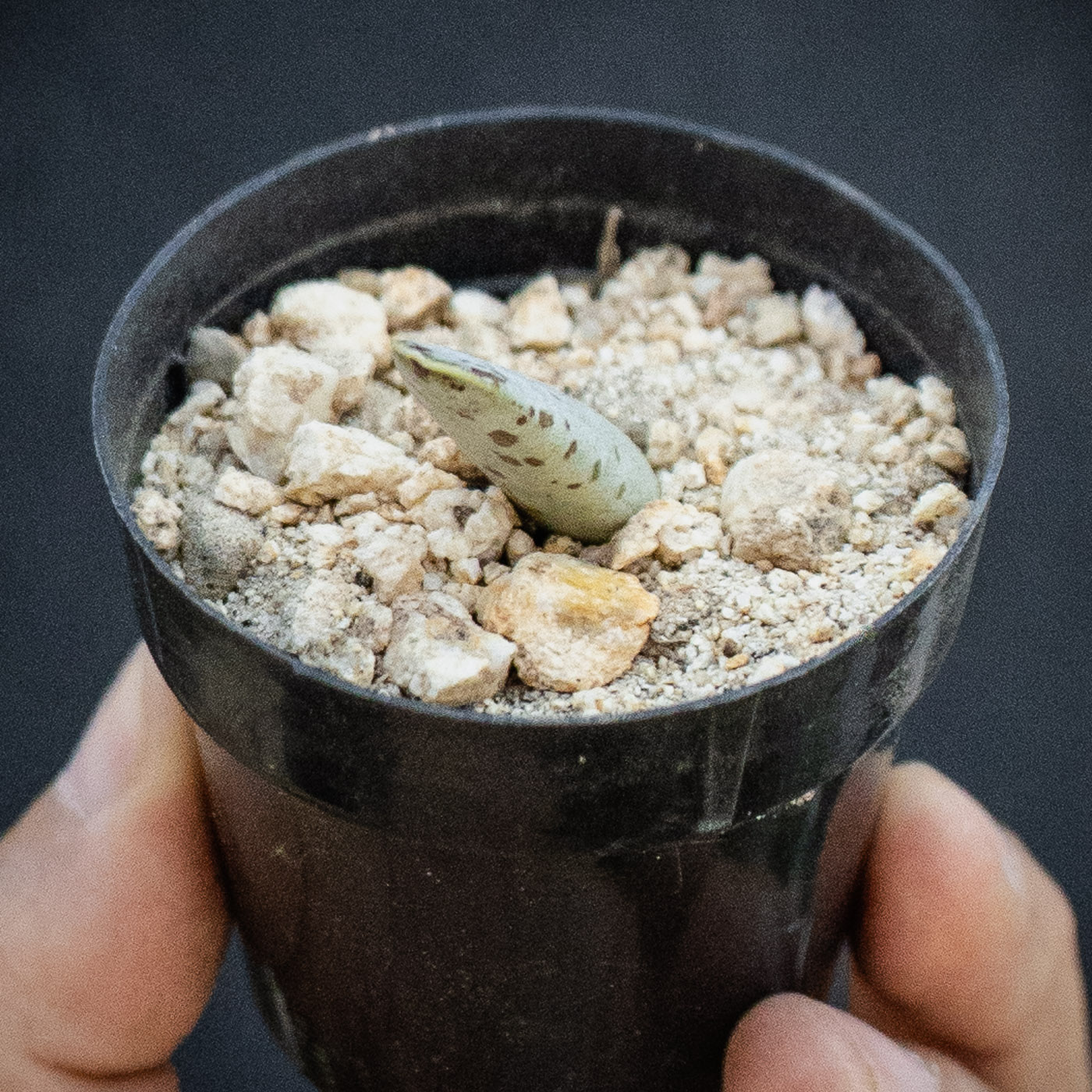
Adromischus mammillaris f. blue
Acquired3 months ago6/18/2026
Notes
Retaining the exact evolutionary programming of its wild ancestors, this blue selection carries out its primary vegetative growth and root exploration during the cool, temperate months of autumn and spring. It slows its metabolism down significantly during the intense heat of mid-summer, relying on its exceptionally water-dense, turgid foliage and light-reflecting waxy bloom to withstand intense light and prolonged drought. In late summer, it pushes up a tall, slender, unbranched inflorescence bearing small, inconspicuous tubular white-to-pink flowers. In cultivation, it has an absolute intolerance for damp, suffocating potting media, which can cause its root system to instantly collapse; it thrives best in an aggressively lean, porous mineral substrate (such as 85% to 90% premium pumice, fine granite grit, and crushed quartz) and must be watered with a highly disciplined hand only when the medium is completely bone-dry.
Origin
South Africa / Cultivation selection. While typical Adromischus mammillaris populations (such as the Buffelspoort variants) lean toward pale olive or muted grey-green tones, the "Blue Form" is an exceptional horticultural selection derived from ancestral stock native to the rocky interior of the Western Cape. It is highly sought after for its intense glaucous morphology, developing short, decumbent-to-erect branching stems packed with remarkably plump, spindle-shaped (fusiform) leaves that are completely coated in a heavy, powdery white epicuticular wax. This thick wax layer gives the entire plant a striking, luminous sky-blue to silvery-cyan hue. Under strong, high-intensity light and careful water management, the sharp, tapered tips of the smooth, unspotted blue leaves flush with a brilliant, contrasting wine-red to deep violet edge.
Note: Coordinates indicate a general region for educational purposes and are not exact locations. Please do not use them for collection or poaching.