2026/06/13
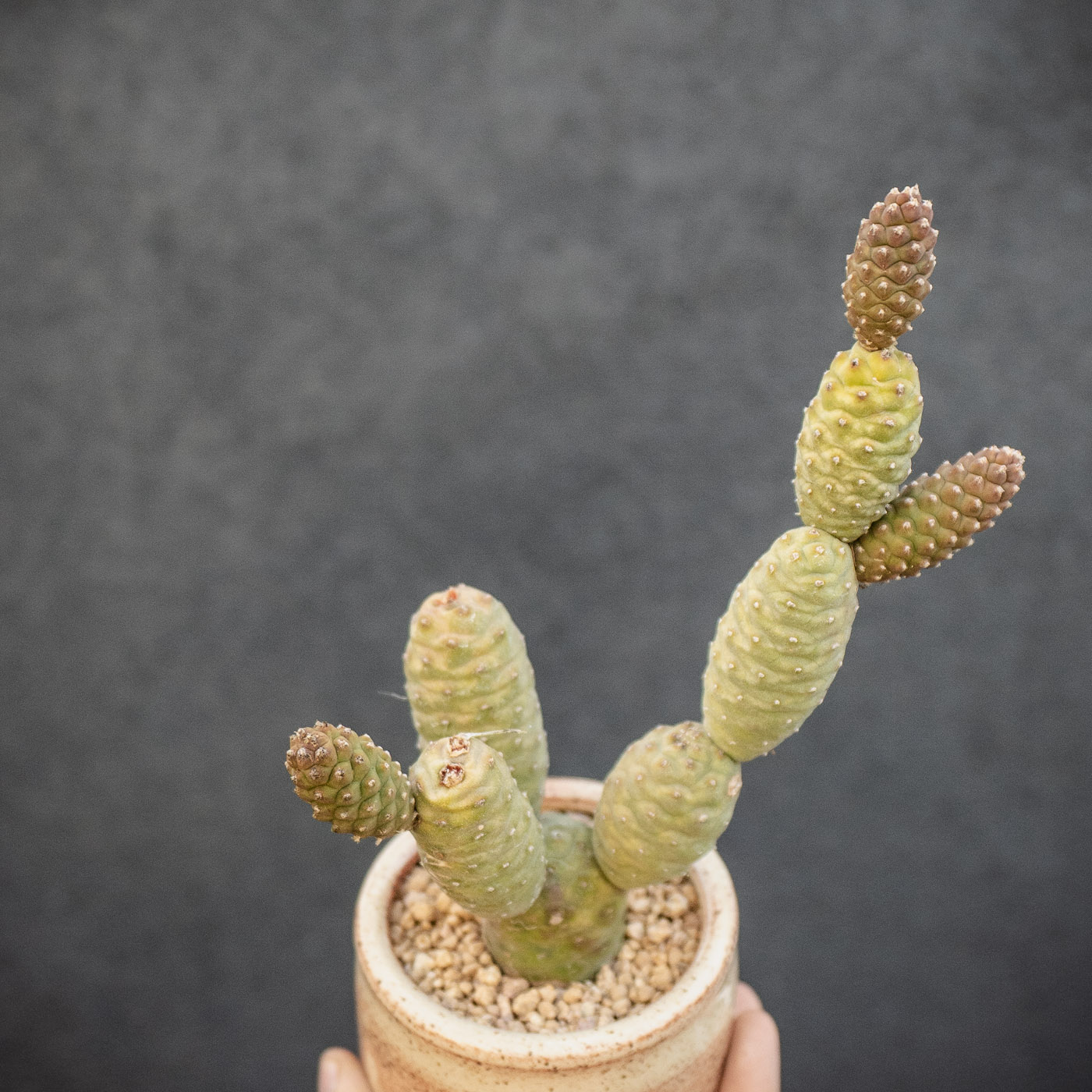
Tephrocactus articulatus var. inermis
Pine Cone Cactus
Acquired4 months ago5/7/2026
Notes
This cactus is a summer-grower, aligning its activity with the warmer months when sporadic moisture might be available in the Argentine high desert. It grows by stacking new, globose segments (cladodes) on top of one another. These segments are intentionally loosely attached; in the wild, this allows them to be easily detached by passing animals or wind, rolling away to take root elsewhere—a form of asexual reproduction. It produces relatively large, delicate white-to-pinkish flowers in late spring or early summer.
In cultivation, the "inermis" variety is prized for its architectural, "stacking stone" aesthetic and its tactile, spine-free surface. It requires an exceptionally gritty, mineral-heavy substrate to prevent the fragile root system from suffocating. A mix of 80% pumice and 20% organic material is ideal, as it allows for the rapid wet-dry cycles the plant experiences in the Andean rain shadow. Because it is adapted to intense high-altitude sunlight, it needs very bright light to prevent the segments from becoming elongated or "etiolated." In the winter, it should be kept completely dry and can withstand significant cold if the substrate is devoid of moisture, mimicking the freezing, dry winters of its native Argentine provinces. Care should be taken when moving the plant, as the segments can "snap" off with even slight pressure.
Origin
This variety is native to the arid, high-elevation regions of Western Argentina, particularly in the provinces of Mendoza, San Juan, and La Rioja. It grows in extremely harsh, rocky environments, often found on sandy plains or gravelly slopes of the Andean foothills. The species Tephrocactus articulatus is highly polymorphic, but the var. inermis is specifically distinguished by the total absence of the papery, strap-like spines commonly found in other varieties, leaving it with smooth, geometric segments that resemble small pine cones or stones.
Note: Coordinates indicate a general region for educational purposes and are not exact locations. Please do not use them for collection or poaching.