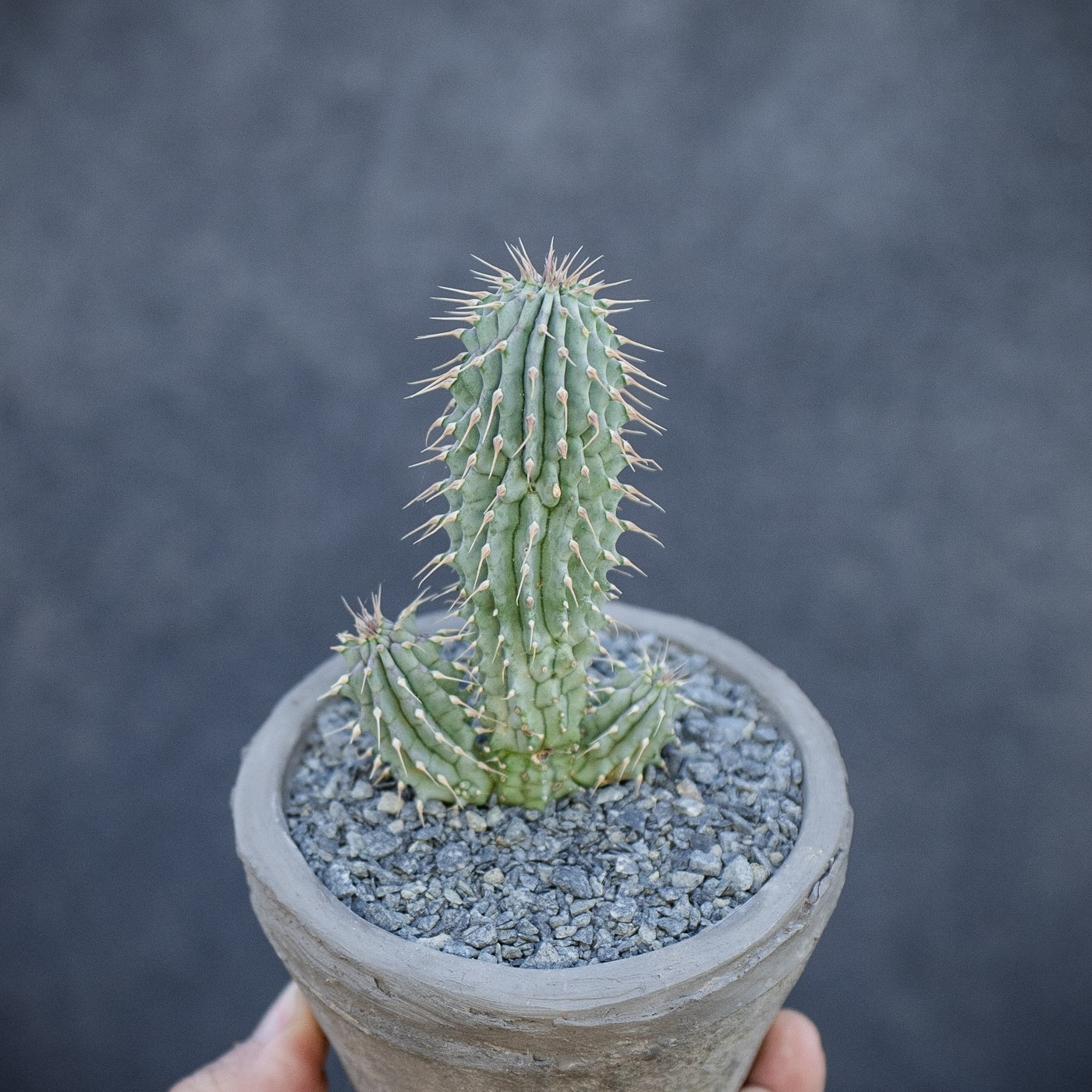
Hoodia parviflora
Acquired8 days ago10/10/2026
Notes
Adapted to torrential, highly irregular desert downpours followed by intense baking sun and deep drought, this African succulent has a massive, sensitive root system and is notoriously prone to stem and root rot if exposed to lingering dampness. In a coastal Zone 10b environment, it requires maximum solar radiation and uninhibited airflow to prevent moisture stress. It demands an uncompromisingly porous, fast-draining mineral substrate, making an 80% to 90% premium pumice blend cut with coarse decomposed granite and calcined clay ideal. Cultivating this specimen in a deep, highly breathable raw cement pot is essential to accommodate its extensive root system while guaranteeing rapid moisture evacuation. Water deeply during warm summer growth cycles—letting the substrate dry out completely between soakings—and enforce a strict, bone-dry winter dormancy beneath a solid polycarbonate greenhouse roof to protect against cool, damp seasonal rains.
Origin
South Africa and Namibia. Endemic to the arid, stony plains, rocky limestone ridges, and semi-desert scrublands of the Karoo and southern Kalahari regions. In habitat, it grows under harsh, blazing sun, often sheltering partially beneath nurse shrubs or tucked directly into mineral-rich calcrete gravel. It forms a striking, multi-stemmed succulent shrub comprising upright, succulent, grey-green to blue-green stems with prominent rounded tubercles and sharp, reduced leaf remnants. Unlike the larger, showy foul-smelling flowers of some Hoodia species, Hoodia parviflora produces clusters of small, cup-shaped, pale yellowish-brown to brownish-purple flowers directly near the apical tips of the stems during the warm season.
Note: Coordinates indicate a general region for educational purposes and are not exact locations. Please do not use them for collection or poaching.