2026/05/14
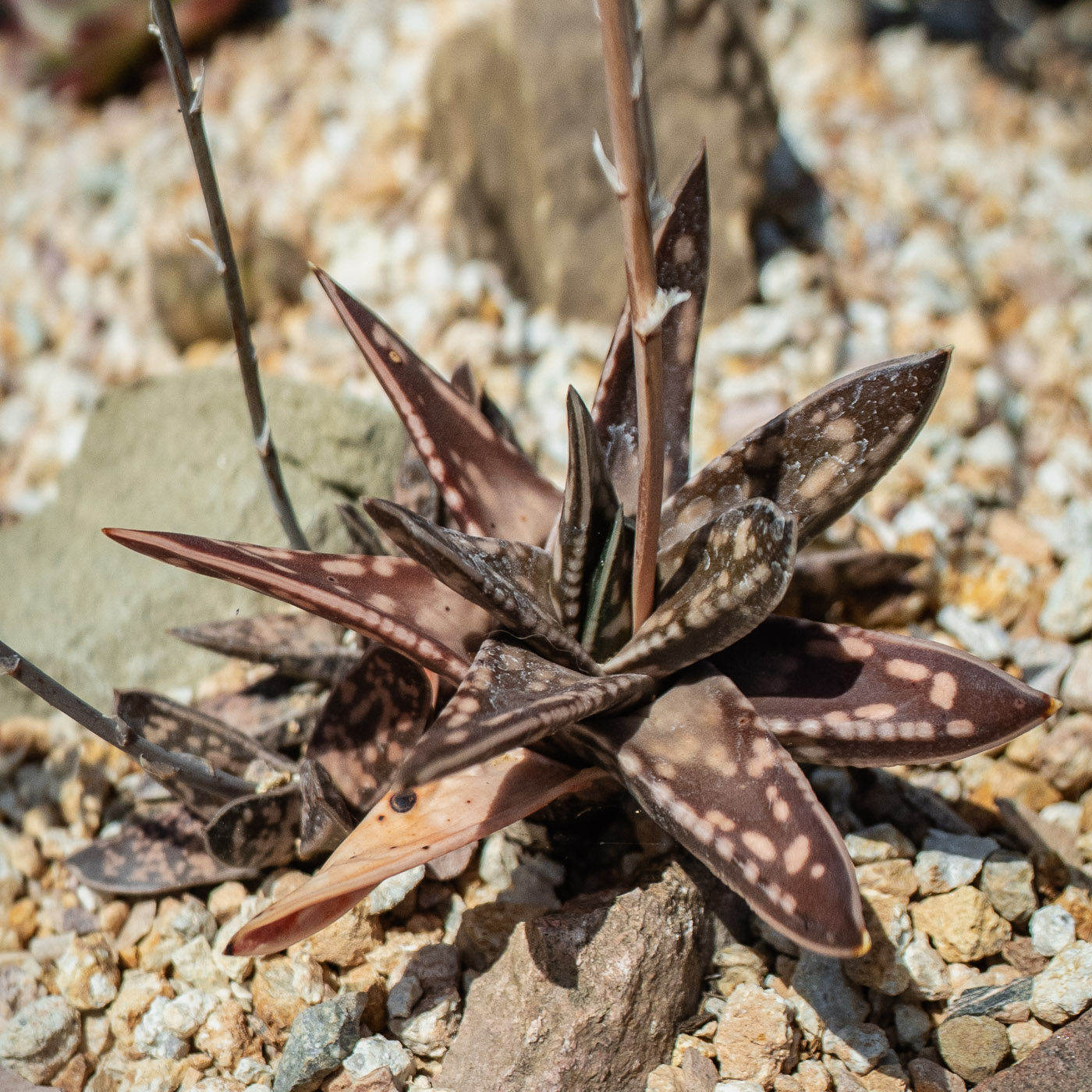
Gasteria bicolor var. liliputana
Dwarf Gasteria
Acquired5 months ago4/25/2026
Notes
This plant follows the rainfall patterns of the Eastern Cape, showing the most growth during the transition periods of spring and autumn. It is highly opportunistic and will respond quickly to moisture at any time of year, provided temperatures are moderate. In the wild, it often flowers in mid-summer, producing small, stomach-shaped (gasteriform) blooms that are pinkish-red with green tips, hanging from a slender, arching raceme.
In cultivation, this is one of the most shade-tolerant succulents, making it ideal for the lower shelves of a greenhouse or filtered light beneath larger specimens. It requires a very porous, mineral-heavy substrate—such as the 80% pumice and 20% organic ratio—which is essential because its thick, fleshy roots are prone to rot if kept in stagnant, damp soil. Despite its small size, it produces a robust root system that can eventually crack plastic pots if left to clump for too long. To maintain its dark green, mottled foliage and compact "liliput" form, it should be kept in bright, indirect light; too much direct sun will cause the leaves to turn a stressed purple or brown, while too little light will cause the rosettes to stretch and lose their characteristic density.
Origin
This diminutive variety is native to a very specific region in the Eastern Cape Province of South Africa, primarily located near Grahamstown. It is a specialist of the "Albany Thicket" biome, where it grows in the deep shade of larger shrubs or tucked tightly into the crevices of rocky outcrops. Unlike the standard Gasteria bicolor, which can grow quite large, the liliputana variety has evolved to stay exceptionally small, often forming dense, mounding colonies that hide beneath leaf litter and the protective canopy of thorny vegetation to escape the intense African sun.
Note: Coordinates indicate a general region for educational purposes and are not exact locations. Please do not use them for collection or poaching.