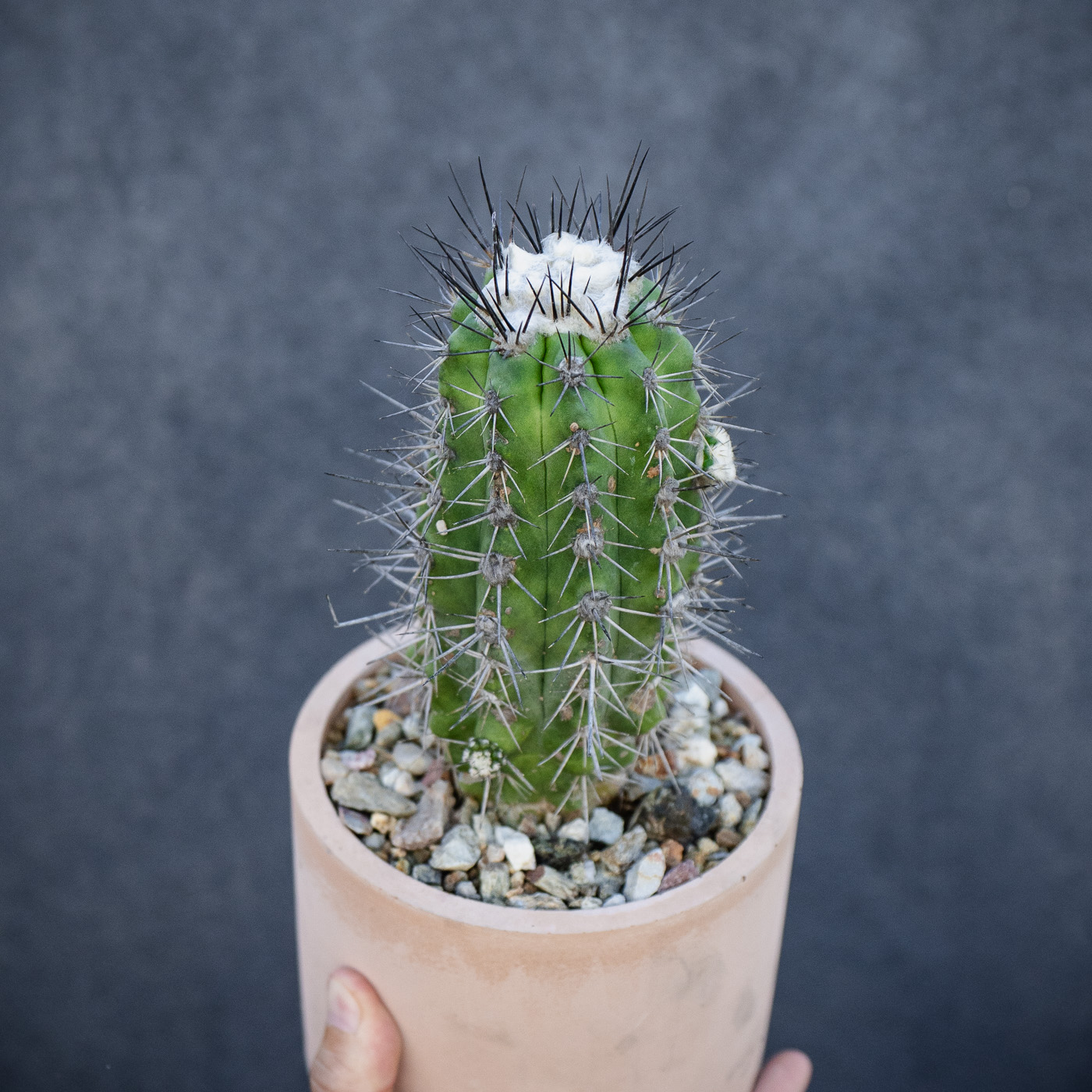
Copiapoa montana
Acquired17 days ago10/1/2026
PotterPrickly Point
Notes
Evolving in the fog-bound coastal mountains of the Atacama, this species derives vital moisture from the dense camanchaca fogs. Because of its substantial, water-storing taproot, it is exceptionally vulnerable to root rot if exposed to stagnant moisture or heavy soils. In a coastal Zone 10b environment, it thrives when cultivated in a hyper-porous, inorganic mineral substrate—such as your standard gritty 80% volcanic pumice blend cut with calcined clay and decomposed granite to mimic its native granitic scree. Housing the plant in a deep, highly breathable raw cement pot provides necessary room for the large taproot while rapidly wicking away residual moisture around the root zone. Water should be applied conservatively during warm, breezy periods of summer growth, allowing the pot to dry out completely between soakings, and strictly withheld throughout a cold, bone-dry winter dormancy beneath a solid polycarbonate roof to protect against seasonal rains.
Origin
Chile. Endemic to the hyper-arid coastal mountains of the Antofagasta Region, heavily concentrated in the rugged coastal hills, sea cliffs, and dry quebradas north of Paposo and extending toward Taltal. In habitat, it grows at elevations ranging from near sea level up to 800 meters, anchored directly into rocky scree and steep granitic slopes. It forms solitary to freely clumping mounds of small, globose to short-cylindrical stems that typically feature a dark reddish-brown, bronze, or dark green-grey epidermis. The ribs are notched into distinct, rounded tubercles and armed with short, slightly curved, needle-like spines ranging from pale yellowish-brown to dark gray. Deep beneath the soil, it anchors itself via a large, fleshy, tuberous taproot. In late spring and summer, it produces satiny, bright yellow, funnel-shaped flowers from the apical wool.
Note: Coordinates indicate a general region for educational purposes and are not exact locations. Please do not use them for collection or poaching.