2026/06/29
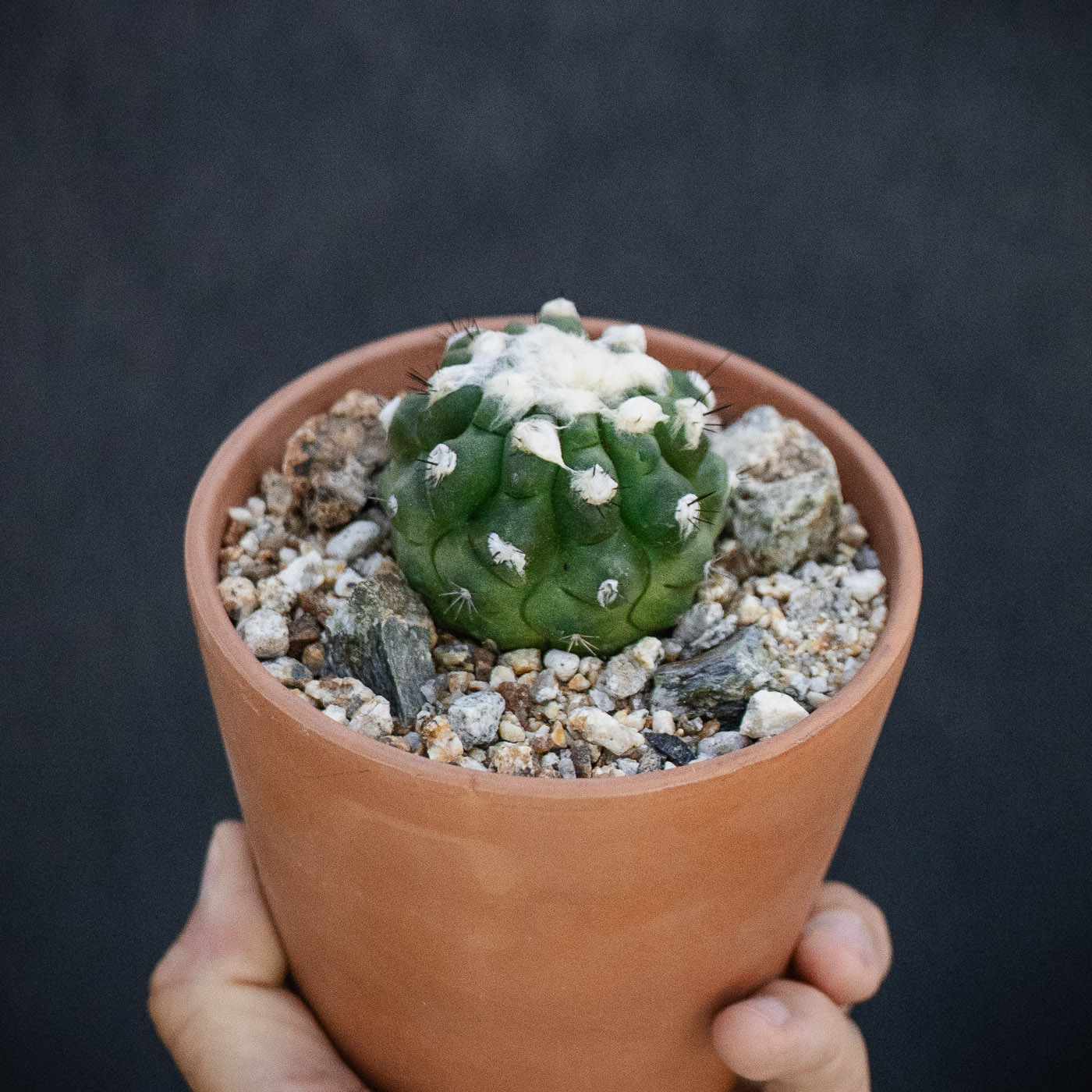
Copiapoa esmeraldana
Acquired3 months ago6/28/2026
Notes
Endemic to the hyper-arid coastal cliffs where rain is a rare anomaly, this dwarf geophyte relies entirely on the heavy camanchaca fog that blankets the hills of Las Lomitas during the cooler morning hours. The thick white wool at the plant's apex absorbs atmospheric condensation, while the massive, fleshy taproot anchors it deep into the rocky granitic scree, acting as a massive water-storage organ. The plant carries out its primary, incremental growth and root exploration during the cool autumn and spring shoulder seasons, slowing its metabolism to an absolute standstill to combat the intense solar radiation of mid-summer. In mid-spring to early summer, sweet-scented, brilliant yellow campanulate (bell-shaped) flowers emerge directly from the woolly crown. In cultivation, its large, soft taproot makes it exceptionally prone to fungal rot if exposed to stagnant moisture or dense organics. It demands a highly porous, 90% to 95% purely mineral potting substrate (such as premium volcanic pumice, coarse sand, and decomposed granite) and must be watered with extreme discipline only during buoyant, warm weather.
Origin
Chile. This critically endangered miniature cactus is native to a highly restricted coastal zone within the Atacama Desert, specifically high on the granitic coastal hills (lomas costeras) of Las Lomitas, located just south of Esmeralda within the Pan de Azúcar National Park (Taltal Department). Growing at elevations around 600 meters above sea level, it inhabits steep cliff edges and gravel-strewn terraces overlooking the Pacific Ocean. Copiapoa esmeraldana is a small, slow-growing geophytic species characterized by a soft, succulent, globose stem that reaches 3.5 to 7 cm in diameter. The epidermis ranges from a rich olive-green to a dark, stress-tinted purplish-brown, topped with a deeply depressed apex filled with dense white wool. It features a massive subterranean taproot system with a highly constricted, narrow neck. Its ribs (13 to 16) are deeply notched into neat, chin-shaped tubercles armed with straight, needle-like spines that emerge a sharp brownish-black before weathering to a soft ash-grey.
Note: Coordinates indicate a general region for educational purposes and are not exact locations. Please do not use them for collection or poaching.