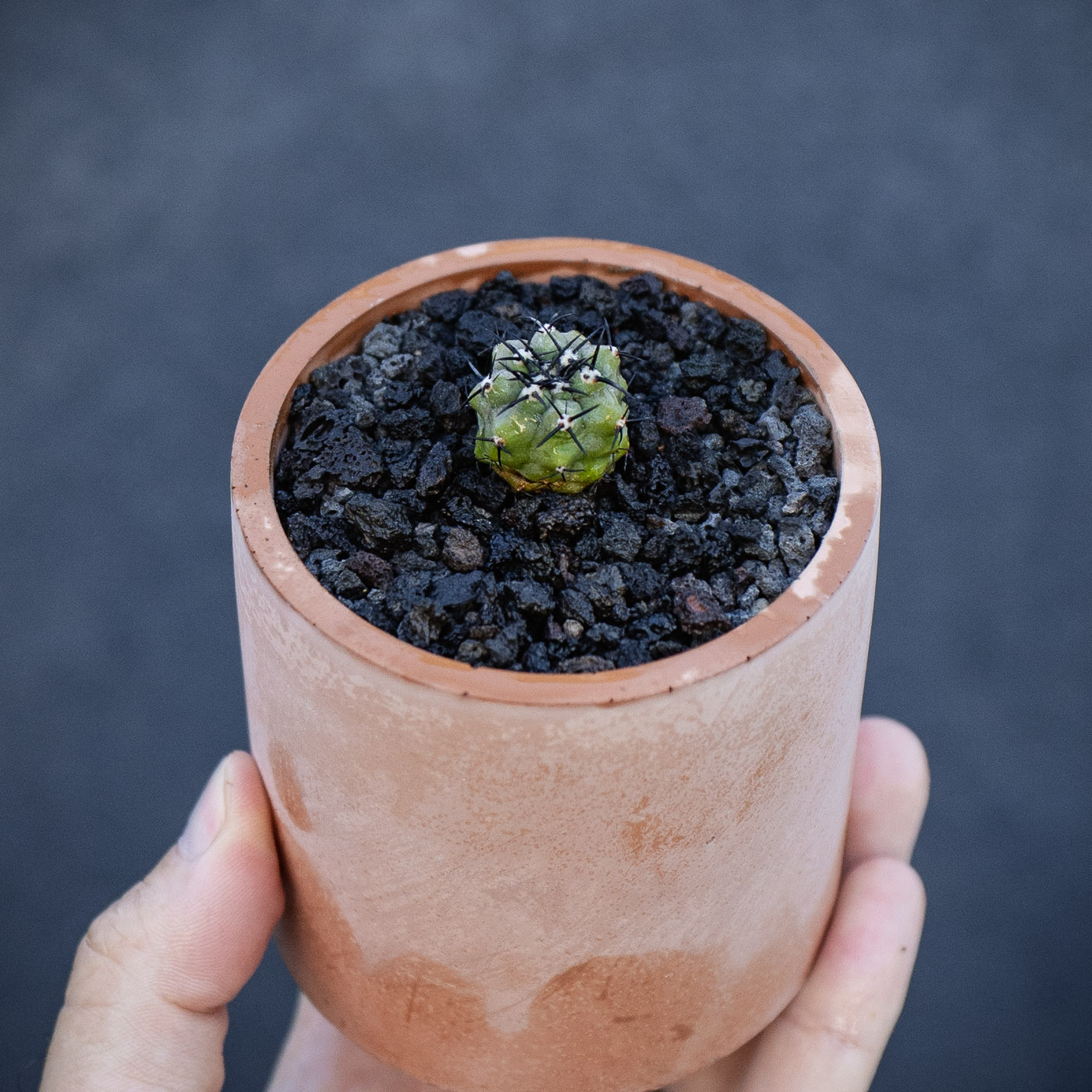
Copiapoa calderana subs. atacamensis
Acquired16 days ago10/2/2026
PotterPrickly Point
Notes
Evolving in one of the dryest coastal corridors on Earth where rainfall is extremely scarce, this subspecies relies almost entirely on ambient moisture condensed from the atmospheric camanchaca sea fogs. In a coastal Zone 10b environment, maintaining strict aridity and excellent airflow is critical to preserve its compact shape and dark spination while preventing taproot rot. It demands an uncompromisingly porous, virtually inorganic mineral substrate, making your preferred 80% premium pumice blend cut with decomposed granite ideal to match its native granitic scree. Housing the plant in a deep, highly breathable raw cement pot gives its thick taproot room to stretch while ensuring excess water wicks away rapidly. Water should be supplied conservatively during warm, breezy periods of summer growth—allowing the substrate to dry out thoroughly between applications—and strictly withheld during a bone-dry winter dormancy, protected under a solid polycarbonate greenhouse roof against cold seasonal rains.
Origin
Chile. Endemic to the hyper-arid coastal desert in the Antofagasta Region of northern Chile, occurring primarily along the rugged coastal range between Paposo, Blanco Encalada, and Cerro Moreno / Morro Moreno. In its extreme habitat, it grows across barren, windswept granitic slopes, dry quebradas (gullies), and rocky sea cliffs at elevations from near sea level up to 1,100 meters. It forms solitary or heavily clumping mounds of grey-green to pale greyish stems armed with long, dense, needle-like spination ranging from dark reddish-brown to black. A deep, extensive tuberous root system anchors the plant into stony scree with virtually no organic matter. During summer, it pushes satiny pale yellow flowers from its densely woolly apex.
Note: Coordinates indicate a general region for educational purposes and are not exact locations. Please do not use them for collection or poaching.